Selecting the correct tempered glass for a waterdrop display mobile phone requires more than matching size.
Display shape, notch design, bezel coverage, and camera cut accuracy together decide whether the screen glass truly protects or merely covers the display.
This child guide explains waterdrop / dewdrop / Infinity-U displays, the need for camera-cut safety glass, and how correct compatibility prevents common fitting issues seen in daily use.
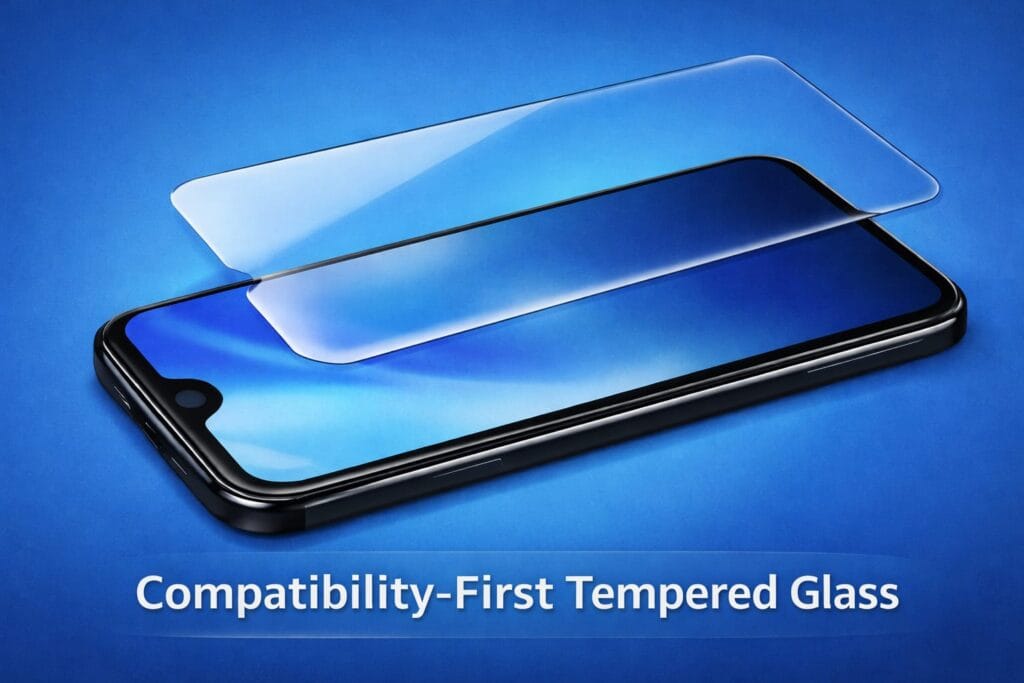
✅ Quick Compatibility Check (Before You Read Further)
Use this shortcut if you want an instant answer:
✔️ Your phone has a small V-shaped or U-shaped notch at the top center
✔️ The front camera sits inside the display area, not in a hole
✔️ The tempered glass has a matching V-cut or U-cut for the camera
❌ The glass is not full-display / no-cut / edge-to-edge
👉 If all ✔️ apply, this is the RIGHT tempered glass for your phone.
👉 If not, do not proceed — wrong glass may cause camera or touch issues.
(If you’re still in doubt, the sections below explain the logic in detail.)
🔀 Important Navigation Suggestion
If your phone does NOT have a waterdrop / dewdrop / infinity U notch, this page will not help you.
Please move directly to the correct guide to avoid confusion:
- Punch-Hole / Hole-Punch camera displays → Explore Punch-Hole Display Tempered Glass
- Dynamic Island displays → Explore Dynamic Island Tempered Glass
- Notch-less or pop-up camera displays → Explore Notch-less Display Tempered Glass
- Wide notch displays → Explore Wide Notch Display Tempered Glass
- Classic bezel displays with separate camera area → Explore Classic Bezel Tempered Glass
👉 Each display follows its own cut logic.
Choosing tempered glass based on the correct display structure helps prevent camera obstruction, fitting issues, and unnecessary replacements.
Understanding the Waterdrop (Dewdrop / Infinity-U) Display Design
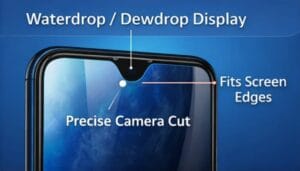
A waterdrop display is recognized by a small V-shaped or U-shaped notch positioned at the top center of the screen, created to house the front camera without occupying extra display space.
This display style is also referred to as:
- Waterdrop notch display
- Dewdrop screen
- Infinity-U display
- U-notch or V-notch design
📌 Because the camera lies within the active display area, tempered glass for this display MUST include a camera cut.
Why Camera-Cut Tempered Glass Is Mandatory for Waterdrop Displays
Unlike punch-hole or notchless displays, waterdrop screens cannot use no-cut or full-display glass safely.
Correct compatibility logic:
- Waterdrop / Infinity-U display → Camera cut REQUIRED
- Uncut / edge-to-edge glass → ❌ incorrect fit
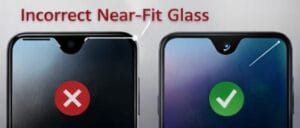
Using wrong or near-fit glass may result in:
⚠️ Front camera obstruction
⚠️ Lifting near the notch
⚠️ Reduced touch sensitivity
⚠️ Poor long-term protection
This is why display structure matters more than size alone.
Common Names Used for Tempered Glass in the Market
Depending on region and trade usage, waterdrop display protection glass may be called:
- Tempered Glass
- Safety Glass
- Screen Glass
- Display Protection Glass
- Tempered Screen Protector
Although naming varies, the functional requirement remains unchanged:
👉 Accurate camera cut + proper screen coverage.
Types of Camera Cuts Used in Waterdrop Display Glass
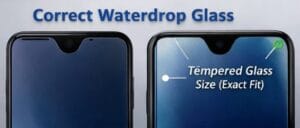
Waterdrop tempered glass may feature different cut descriptions, such as:
- V-Cut tempered glass
- U-Cut screen glass
- Waterdrop notch cut glass
- Infinity-U camera cut protector
🔍 The cut shape must align precisely with the phone’s notch design.
Approximate or oversized cuts may look acceptable initially but often fail during daily usage.
Privacy & Matte Tempered Glass on Waterdrop Displays (Read Carefully)
Privacy and matte tempered glass are increasingly used on waterdrop display phones, especially in budget and mid-range segments.
However, waterdrop displays are less forgiving when it comes to optical coatings near the front camera.
Because the front camera sits inside the display notch:
- Privacy filters may partially block light entering the camera
- Matte coatings may soften selfie clarity
- Low-grade coatings can create haze around the V-cut or U-cut area
Two important clarifications:
- Camera blur is caused by glass quality and coating layers, not by the presence of a camera cut
- A correct V-cut or U-cut does not reduce camera performance when glass quality is proper
📌 Recommendation:
For waterdrop displays, privacy or matte tempered glass should be chosen only when:
- The camera cut is precisely shaped
- Optical quality is verified
- The glass is designed specifically for waterdrop notch displays
This prevents false camera complaints and unnecessary replacements
Two Common Market Practices You May Encounter
While selecting waterdrop display tempered glass, you may notice two different practices commonly seen in the market:
1️⃣ Correct Display-Specific Glass
- Designed for waterdrop / Infinity-U displays
- Includes a precise V-cut or U-cut
- Balanced for camera alignment and screen coverage
- Performs consistently in daily use
2️⃣ Near-Fit or Size-Only Glass
- Selected mainly by diagonal size
- Camera cut may be oversized, misplaced, or absent
- Appears acceptable during installation
- Develops issues over time (lifting, blur, dust entry)
📌 Both types are sold openly, but only the first follows display structure logic.
This guide focuses exclusively on structure-correct compatibility, not temporary visual fit.
Real-World Fit Factors (Beyond Display Type)
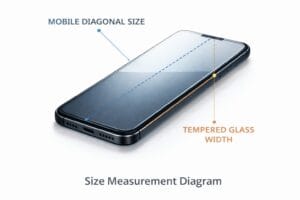
Even with the correct waterdrop display glass and camera cut, long-term performance depends on fit behavior, not just display category or diagonal size.
How size and fit are actually determined:
- Length mentioned (diagonal size):
This is the mobile brand’s screen size reference, used only for general identification. - Width tolerance (critical factor):
Tempered glass must match the active display width, not the phone’s outer frame or body size. - Bezel thickness & notch spacing:
Small variations affect how the glass settles around the V-cut or U-cut area, even when diagonal size appears identical. - Edge clearance:
Proper inset spacing prevents lifting caused by hand pressure or daily handling. - Case compatibility:
Most waterdrop tempered glass is intentionally designed slightly smaller than the full front panel to avoid pressure cracks from back covers.
📌 Important reality:
Two phones with the same diagonal size may still require different waterdrop tempered glass due to bezel width, notch placement, and edge behavior.
Correct fit protects the display without stress, peeling, or repeat replacements.
Case-Friendly Design & Edge Coverage
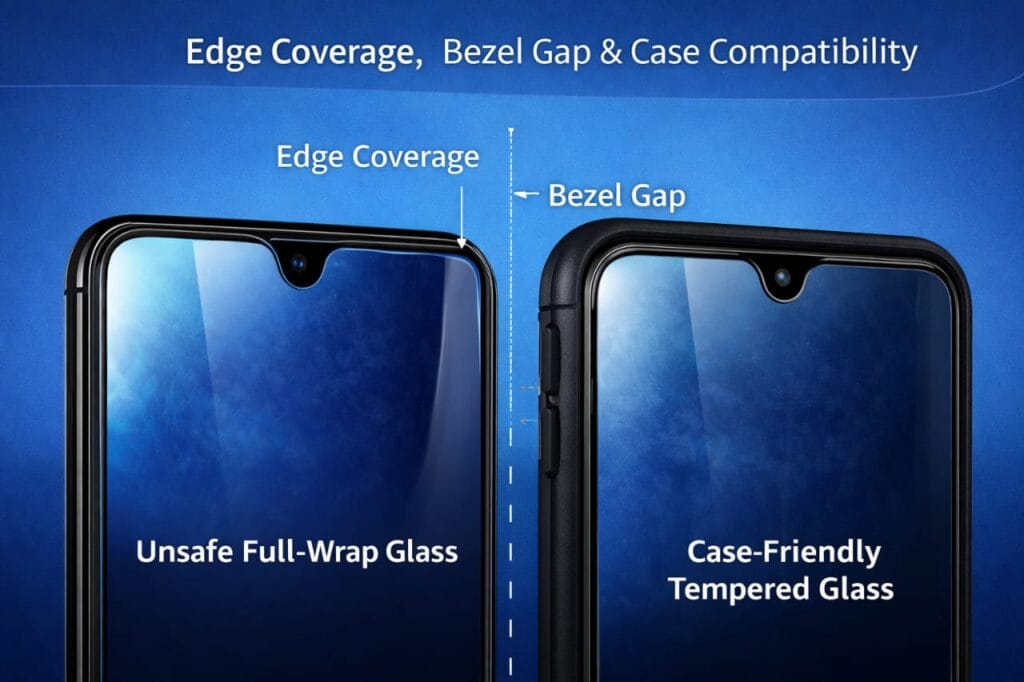
Most waterdrop display safety glasses are designed to be:
- Slightly smaller than the full front panel
- Compatible with protective back covers
This design helps prevent:
- Edge lifting
- Pressure cracks caused by tight cases
Correct fit protects the screen without interfering with daily accessories.
Manufacturing Quality Still Decides the Outcome
Even when display type, camera cut, size, and case compatibility are correct, the final result depends on how the tempered glass itself is made.
Key quality elements that matter in daily use:
- Edge finishing & curvature
Poorly polished or uneven edges increase lifting, chipping, and hand discomfort. - Bezel tuning accuracy
High-quality glass is precisely tuned to display borders, not roughly scaled by size. - Adhesive (gum) uniformity
Adhesive must be evenly distributed across the glass.
Patchy or weak adhesive causes: - Halo effects
- Touch inconsistency
- Early peeling
- Glass flatness & tempering consistency
Low-grade tempering leads to micro-warping, which becomes visible only after installation.
📌 What “good brand & high quality” actually means:
Not a name — but consistent edge shaping, accurate sizing, proper adhesive quality, and reliable tempering standards.
This is why two glasses with identical size and cut can perform very differently in real-world use.
Replacement Cycle & Practical Usage Advice
Tempered glass is a sacrificial protection layer, not a lifetime solution.
Recommended replacement:
- Every 120–150 days, or
- Immediately after visible cracks or edge damage
A damaged protector absorbs less impact and may compromise screen safety.
🔍 Pro Tip (Why This Page Decides Compatibility This Way)
If you’re wondering how this page determines what is “right” or “wrong” tempered glass, the logic comes from understanding display structure first — not model names or sizes.
Our main Tempered Glass Gold Guide explains the core principles behind display types, camera placement, and cut rules that guide all compatibility decisions here.
This page applies those principles to waterdrop displays so you can choose with clarity, not guesswork.
Find Your Mobile Model (Waterdrop Display)
Use the live search below to find the correct waterdrop display tempered glass for your mobile model.
(Search helps identify compatibility based on display design, cut type, and size logic — not just approximate fit.)
Trader / Business Reminder: Model names above are for reference and stock verification only, listed as mentioned on the box. Always confirm the actual device design and camera placement before selecting tempered glass.
Who This Guide Is Designed To Help
👤 End Users
- Understand why camera-cut glass is essential
- Avoid incorrect installations
🏪 Retailers
- Reduce return cases
- Improve customer trust through correct guidance
🔧 Repair Technicians
- Avoid near-fit practices
- Maintain professional installation standards
📦 Wholesalers
- Support trade education
- Reduce compatibility confusion at scale