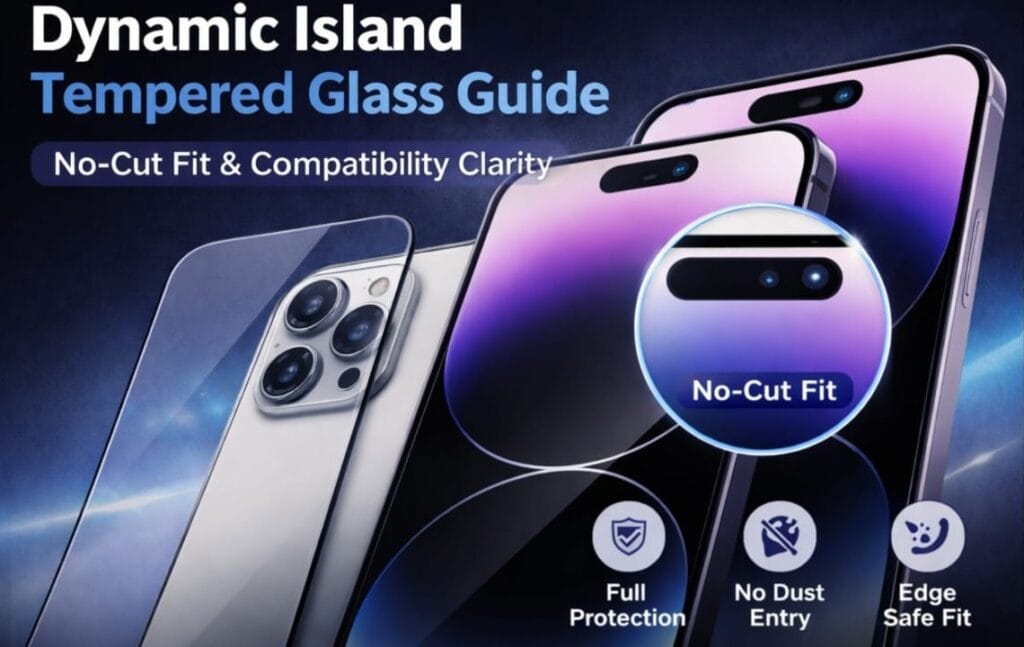
Choosing tempered glass for a Dynamic Island display mobile is not just about size matching.
Sensor placement, edge behavior, optical clarity, adhesive quality, and structural strength together decide whether protection remains stable or creates long-term issues.
This child guide explains how Dynamic Island displays work, what type of tempered glass is technically suitable, why full-display (no-cut) glass is generally recommended, when camera-cut glass may still be used, and how to avoid common mistakes seen in real-world installations.
✅ Quick Compatibility Check (Before You Read Further)
Use this shortcut for instant clarity:
✔️ Your phone has a pill-shaped Dynamic Island at the top center
✔️ The tempered glass covers the display uniformly without unnecessary openings
✔️ Sensors are visible clearly through transparent glass
❌ The glass is not oversized, poorly aligned, or roughly cut
👉 If all ✔️ apply, this is the correct compatibility direction.
👉 If not, the wrong glass may cause dust entry, lifting, or sensor inconsistency.
(The sections below explain the reasoning in detail.)
🔀 Navigation Checkpoint
If your phone does NOT have a dynamic island / pill / capsule shape, this page will not help you.
Please move directly to the correct guide to avoid confusion:
- Punch-Hole / Infinity-O → Explore Punch-Hole Display Tempered Glass
- Waterdrop / Infinity-U → Explore Waterdrop Display Tempered Glass
- Notch-less / Pop-up Camera → Explore Notch-less Display Tempered Glass
- Wide Notch → Explore Wide Notch Display Tempered Glass
- Classic Bezel → Explore Classic Bezel Tempered Glass
👉 Each display follows its own cut logic.
Correct display identification prevents sensor obstruction, edge lifting, and unnecessary replacements.
Understanding the Dynamic Island Display Design
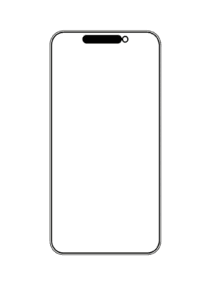
A Dynamic Island display uses a central pill-shaped sensor zone embedded within the active display area.
This zone integrates multiple components such as:
- Front camera
- Face recognition sensors
- Proximity and ambient sensors
Key structural detail:
📌 The Dynamic Island is surrounded by display pixels, not located at the display edge.
This design allows sensors to function through optical glass coverage, which directly affects tempered glass compatibility.
Common Names Used for Tempered Glass in the Market
Depending on region, trade habits, or seller terminology, Dynamic Island display protection glass may be referred to as:
- Tempered Glass
- Safety Glass
- Screen Glass
- Display Protection Glass
- Full Display Glass
- No-Cut Tempered Glass
Although naming varies, the functional requirement remains unchanged:
👉 Correct coverage + correct sensor logic + stable edge fit
A different name does not change whether the glass is suitable or not.
Types of Camera Coverage Used in Dynamic Island Tempered Glass
Dynamic Island display tempered glass is generally available in two formats:
1️⃣ No-Cut (Full Display) Tempered Glass
(Technically preferred & structurally balanced)
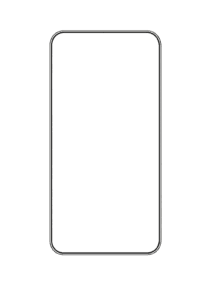
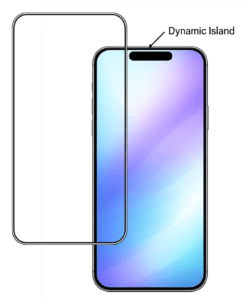
- Glass fully covers the Dynamic Island area
- Sensors remain visible through high-transparency optical glass
- No weak cut edges around sensitive zones
📌 This format aligns with Dynamic Island display design when glass quality is good.
2️⃣ Dynamic Island Camera-Cut Tempered Glass
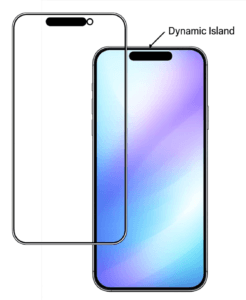
(Optional, quality-dependent)
- A physical cut exposes the Dynamic Island area
- Sensors remain completely uncovered
- Often chosen when optical quality of glass is limited
📌 This format is not required by display design but exists due to market and quality variations.
Why Camera-Cut Glass Is Generally Not Recommended
Even when produced by a good brand or acceptable quality level, camera-cut tempered glass introduces avoidable compromises that are not required by Dynamic Island display structure.
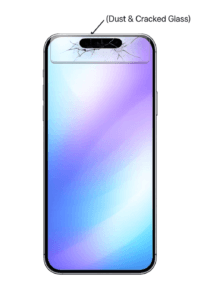
⚠️ Using cut glass may result in:
- Face recognition failures
Exposed sensor zones are more sensitive to dust, reflections, and alignment changes. - Sensor misalignment
Physical cuts require precise positioning; small deviations during installation can affect long-term accuracy. - Dust entry into sensitive zones
Open edges around the cut allow dust, oil, and moisture accumulation during daily use. - Reduced glass strength around the cut
Any cut weakens tempered glass, increasing the chance of cracking, chipping, or lifting near the Dynamic Island.
📌 These issues often appear after weeks of use, not immediately.
Why Full-Display (No-Cut) Tempered Glass Is Recommended
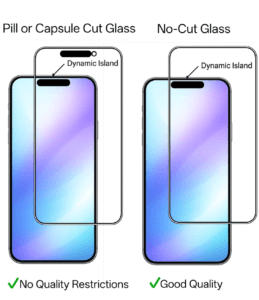
Dynamic Island displays are engineered to operate through glass coverage, not around exposed openings.
With a correctly manufactured no-cut tempered glass:
- Full-display glass safely covers the entire area
- Sensors function through high-transparency optical glass
- Structural strength remains intact without weak cut edges
- Adhesive spreads uniformly, reducing halos and lifting
Because there is no physical opening:
- Dust entry risk is lower
- Alignment remains stable
- Edge pressure is evenly distributed
📌 Dynamic Island displays do not require exposed sensors by design.
Sensor issues usually arise from poor glass quality, uneven adhesive, or low optical clarity — not from glass coverage itself.
Cut vs No-Cut Tempered Glass Comparison
| Feature | Cut Tempered Glass | No-Cut Tempered Glass |
|---|---|---|
| Screen coverage | Partial | Full display |
| Edge protection | Weak near cut | Strong & uniform |
| Dust resistance | Lower | Higher |
| Crack risk | Higher at cut edges | Lower overall |
| Dynamic Island function | Works | Works fully |
Some users may still prefer Dynamic Island cut tempered glass due to familiarity; however, from a protection, durability, and long-term usage perspective, no-cut screen guard aligns better with the actual design of Dynamic Island displays.
Real-World Fit Factors (Beyond Display Type)
Even with correct Dynamic Island glass selection, long-term performance depends on fit behavior, not just display category.
Key stability factors:
- Width tolerance:
Glass must match the active display width, not the outer frame size. - Bezel tuning:
Minor differences affect how stress distributes near the Dynamic Island zone. - Edge clearance:
Proper inset spacing prevents lifting caused by hand pressure or handling. - Case compatibility:
Most Dynamic Island glasses are designed slightly inset to avoid pressure cracks from back covers.
📌 Two phones with similar screen size may still require different Dynamic Island tempered glass.
Manufacturing Quality Still Decides the Outcome
Even when display type and fit logic are correct, real-world performance depends on how the glass is made.
Key quality elements:
- Edge finishing & curvature
Poor polishing increases lifting, chipping, and hand discomfort. - Bezel tuning accuracy
High-quality glass is precisely shaped, not roughly resized. - Adhesive (gum) uniformity
Uneven adhesive causes halo effects, touch inconsistency, and early peeling. - Glass flatness & tempering consistency
Low-grade tempering leads to micro-warping visible only after installation.
📌 “Good brand & high quality” means consistency — not just a name.
Two glasses with identical size and cut can perform very differently.
Replacement Cycle & Practical Advice
Tempered glass is sacrificial protection, not permanent hardware.
Recommended replacement:
- Every 120–150 days, or
- Immediately after visible cracks, lifting, or reduced sensor response
Using worn glass reduces impact absorption and increases failure risk.
🔍 Pro Tip: Read This Before Finalizing Your Choice
Dynamic Island compatibility depends on sensor structure, optical glass quality, and fit behavior, not just whether the glass has a cut or not.
If you want to understand:
- Why no-cut glass is technically preferred when quality is good
- When cut glass is still acceptable and why it exists
- How glass quality, adhesive, and edge tuning affect Face ID and sensors
👉 Read the main Tempered Glass Gold Guide before making a final decision.
This child page focuses on Dynamic Island–specific application.
The Gold Post explains the core principles behind all tempered glass compatibility decisions.
Find Your Mobile Model (Dynamic Island Display)
Use the live search below to find the correct Dynamic Island tempered glass for your mobile model.
No models found for this tempered glass type.
Search helps you locate your model quickly. Final compatibility may vary slightly depending on screen generation and glass quality.
Who This Guide Helps
👤 End Users
- Avoid unnecessary sensor cuts
- Maintain reliable face recognition
- Reduce repeat replacements
🏪 Retailers
- Prevent wrong recommendations
- Reduce post-sale complaints
- Build trust through explanation
🔧 Repair Technicians
- Ensure stable installations
- Avoid near-fit practices
📦 Wholesalers
- Stock correct no-cut variants
- Reduce dead or returned inventory